Showing posts with label Paperback. Show all posts

Sunday, 23 October 2022

A Prince's Errand (Tales of the Amulet Book 1)

Authors: Dan & Robert Zangari
eBook Publisher: LOK Publishing
eBook Date: December 2019
First Published: 2019
Pages: 961
Cover Artist: Kerem Beyit

This time it's the turn of the main story in the Legends of Kalda series, Tales of the Amulet. The first book in this series is called A Prince's Errand, also written by father and son writing partnership of Dan and Robert Zangari.

As I said in my previous post, although this novel was published bfore the prequel The Prisoner of Tardalim, I had already decided to read it after that book. The story is set in exactly the same world as it's prequel, the world of Kalda, with only a few decades (I assume as its never actually defined) having past. The main character in the prequel, Amendal Aramien, is present in A Prince's Errand but only in the peripheral sense, being a wizened old mage that others refer to occasionally. 

Due to the span of time that has elapsed, the number of magic weilders and the number of magical items, called 'tevisrals' is not as prevalent in this time period. The world of Kalda is starting to slowly forget about mythical creatures and historical facts are becoming myths told by parents to their children. The world is still at war, with many nations engaging in espionage and trickery to gain an advantage over thier enemies. The land of Soroth is still on friendly terms with the vastly wealthier nation of Mindolarn, but that alliance is strained as a number of Mindolarnian Emporers are being assassinated at a rather alarming rate.

The death of the latest Emporer is witnessed by Prince Kaescis Midivar and his sister. The Prince swears to avenge his family and maintain his empire's standing by searching the world for information and secrets of the Keepers of Truth and Might, a long forgetton order of beings who protected the world from harm.

Sunday, 16 October 2022

The Prisoner of Tardalim (A Tale of the Amulet Prequel)

Authors: Dan & Robert Zangari
eBook Publisher: LOK Publishing
eBook Date: June 2021
First Published: 2021
Pages: 817
Cover Artist: Kerem Beyit

It's been a long time since I posted a review. Maybe the books I've been reading just haven't been as inspiring as I need them to be in order to be in the 'right' mood for a review? Maybe I got a bit burned out, (all of my own making), from feeling the pressure to update the blog? Or just possibly, the types of genres of the books I've been reading finally got to me and I needed a rest? Whatever it was, I'm glad that I seem to have my mojo back, and more reviews will be following (both on this blog as well as in print if various editors like my submissions).

I'm going to start of with a couple of High/Epic Fantasy novels that I completed whilst on holiday in the last few weeks. Both come from the pen(s) of father and son writing partnership - Dan and Robert Zangari, and take place within their fantasy realm of Kalda. To start off, we are going to look at The Prisoner of Tardalim.

The Zangaris have been self-publishing for a few years now, and have created their own publishing house, Legend of Kalda (LOK for short). So far they have published a few novels and a handful of short stories based in their world. In some ways I consider them in the same arena as Michael J. Sullivan, who has flirted with self-publishing recently to great success (in my opinion) with his Legends of the First Empire sequence and its' follow up, The Rise and Fall. 

In addition, the Zangaris (like Sullivan) have used Kickstarter to initiate some of their products. I'm a big fan of Kickstarter as you'll notice from Digital Bibliophilia's twitter account, where I occassionally post tweets highlighting my support of various fiction products - admittedly most of which are heavily linked with Sherlock Holmes. There are a lot of writers and would-be authors who use this platform to try and get their work out into the 'real' world and I have to say that based upon my experience with this product (and Sullivan's, albeit after having been published), it's one that you shouldn't ignore - there are some really good pieces work out there.

Thursday, 6 January 2022

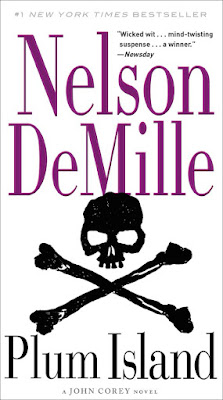
Plum Island (John Corey #1)

Author: Nelson Demille
eBook Publisher: Sphere
eBook Date: September 2008
First Published: 1997
Pages: 574

I've read two books by Nelson DeMille, and both of them have been superb reads. A few years ago I read Up Country, about a former Army Criminal Investigator by the name of Paul Brenner, who is asked to visit Vietnam in order to look into a 30 year old murder. The main character is revisiting his former posting and a lot of the book covered him retracing his steps. It didn't sound like something I would like as the Vietname War is not a conflict I'm very familair with or particularly intersted in, but the sheer power of the writing drew me in and kept me enthralled throughout.

With that pleasant reading experience in mind, I decided to finally take a chance on another novel by Demille. I was in the mood for a good book by an American modern adventure author along the lines of a Clive Cussler, or a Tom Clancy, and I was really surpised and dissapointed that neither of these two were in stock on the shelves of a number of my local Charity shops here in the UK - but I did finally spot a pristine copy of Plum Island for a very reasonable £1, so nabbed it quickly and abandoned the boring book I'd been wading through to immediately start it. 

Nelson Demille was born in 1943 in the city of New York and soon moved out to Long Island. After a stint in the US Army during the late sixties in the aforementioned Vietnam War - where he was awarded the Air Medal, Bronze Star, Vietnamese Cross of Gallantry and Combat Infantryman Badge - he returned to education in order to earn a degree in Political Science and History. He had a string of jobs, but freely admits they "were so boring, I missed Vietnam." His first major novel under his real name was called By the Rivers of Babylon, published in 1978. Before this he had written under a few pen names, particularly as the author of the Ryker series from Leisure Books.

Thursday, 19 August 2021

My Top Twenty Books of all time - Fiction & Non-fiction - July 2021

I didn't think I'd ever do this sort of entry on Digital Bibliophilia. However, inspired by a recent new entry in to this list, and fuelled by a couple of pints on my first night out drinking with work colleagues in nearly two years, I find myself unable to sleep and worried that anything I read will be forgotten in a haze of alcoholic fuzz the next morning. Therefore here we go - I hope it's mildly interesting or leads to someone picking up ones of the books in this list because I think they are fabulous.

So here we go, and in no particular order...

Collected Stories: Raymond Chandler (Everyman's library, No.257) (2002)

I love Chandler. Reading any of his works of fiction is a pleasure every human being should experience at least once in their life. Although his novels are mostly works of genius, I actually preferred this massive collection of his short-form works. This is one book you can't carry around with you - at over 1,300 pages you'll end up with forearms like Popeye the Sailor. Just sit back in your favourite wing-back chair with a bottle of whisky and savour every moment.

The Quincunx: The Inheritance of John Huffam (1995)

I never would have dreamed a book like this would end up being something I'd ever admit to saying was an all-time favourite of mine. I do like to read Charles Dickens every now and again (there's a Dickens biography staring at me on my bookshelf every day - I'll get around to it at some point). This is very much influenced by Dickensian tales. A labyrinthine colossus of a novel over 1,200 pages in length in paperback form that follows the life of a Victorian young man who has no memory of his father, and whose doting mother holds a precious codicil of a last will and testament in a small trinket that never leaves her side. As his life takes turn after turn, and tragedy after tragedy befalls him - he never loses sight of the fact that something on that document hides the secret to his claim to a family fortune. A mesmerising and compelling masterpiece of a novel that is even meticulously structured (word by word) so that the sentence in the middle of the book reveals the secret to our protagonists background (good luck counting the words!).

Shackleton (1989)

A biography of Ernest Shackleton, the famous polar explorer, by Roland Huntford. There are quite a few books on Shackleton by now, but this was one of the earliest, if not the first, to really cover his life, and his astonishing exploration to the South Pole. If you think the notion of old-fashioned heroes is a myth - you need to read the true story of how this man lead his colleagues out of the jaws of hell and, quite literally, across the frozen landscape of Antarctica whilst dragging a boat behind them so they could sail to a desolate island; and then leave them behind whilst he went off on an almost suicidal mission to go and seek out a rescue party to come back to save them. A stone-cold (no pun intended) winner for best biography I'll ever read in my life. Forget anyone who says Captain Scott was a better hero - this guy makes Scott feel like a wuss. If you only have room for one biography on your bookshelf - get this!

Saturday, 31 July 2021

The Initiate Brother (Book #1)

Author: Sean Russell (aka Sean T. Russell)
Publisher: Daw Books
Publication Date: 1991
Pages: 480
Cover Art: Michael Whelan 
Not currently available in eBook format, but available as an Audiobook.

The Initiate Brother by Sean Russell is a long story split into two volumes, of the first half consists mainly of a huge cast of characters with weird-sounding names talking to each other, and not a lot of action or adventure until the final quarter. Contrary to how that introduction might sound, I was so thoroughly impressed by it, that it has forced it's way in to my top twenty favourite books of all time. Depending upon how the second half in this duology pans out, it could even work its way into my top ten of all time - it was that good.

Attributing a genre to this novel written in the early nineties is slightly misleading. Although the setting and background are very heavily influenced by Chinese/Japanese culture, author Russell has created his own fantasy world that could easily read like it has been directly lifted from ancient historical novels such as The Tale of Genji or Romance of the Three Kingdoms. But it's relationship to the fantasy genre is so slight that it almost takes a back seat and gives the reader the impression that they are actually reading a lost novel from our own history.

The Initiate Brother is set in a land dominated by the Empire of Wa, where the ruling Emporer, Akhantsu II, controls the land and waterways over his subjects. To the north the empire of Wa is protected from being invaded by savages by one of many House Clans. The empire has two main religions, the Botahist Order and the Tomsoian Church.

In terms of social status and heriditary, below the Emporer there are many Houses competing for the right to become the next ruling dynasty. Pacts and feuds are commonplace between many of the families, who are all simultaneously grovelling to the current Imperial power whilst scheming behind everyone's backs to futher their own needs and aspirations. Marriages between Houses, or killing off a rival political opponent to greatly advance ones status is a commonplace part of imperial court life.

The Middle Kingdom (Chung Kuo #1)

Author: David Wingrove
Publisher: New English Library
Publication Date: 1989
Pages: 480
Cover Art: Jim Burns (Edition shown)
eBook Publishers: Fragile Media
eBook Date: Jul 2017

After having had such an amazing time reading the Asian-influenced first part of The Initiate Brother, I looked around for another book with a simialr theme. I was immediately tempted by my old collection of Chung Kuo novels.

I've toyed with Chung Kuo since it was published in the late eighties. I was remember being completely sold by my first sight of Book 1, The Middle Kingdom, when it came out with a beautiful cover that was predominently red around the borders, with Chinese dragons drapped over the top corners, and the image of an old Han sitting on a throne (see image below). Over the following thirty years, since I first tried to read the opening volume, it has haunted and daunted me to complete it. I'm going to try REALLY HARD this time to see it through to the bitter end (more on the end down below). But the sheer size of Chung Kuo can be a little intimidating.

The original run lasted for eight weighty tomes, and even though they are brilliantly written by author, David Wingrove, by their very nature I found them a bit difficult to get into at first. For me, the barrier holding me back was the inherent premise of the tale being told. You see, Chung Kuo (the new name for Earth) is about and  alternative future history where Chinese culture has become the dominant power on our planet, and because of that premise the number of characters with Chinese names takes a bit of getting used to. If you can get past this, then you will be truly rewarded with an excellent read.

Over a turbulant period (covered in later editions - see below) of Earth's history, the Chinese (or Han as they are referred to in these books) take over the running of our planet, and they impose their own culture and principles. As they rise to power they begin construction of a city that begins to expand across every continent. 

At the start of this first book, it has been 200 years since the upheavel and the City has all but covered every land mass apart from a few choice areas owned by the very rich and land that has been reserved for food production. The city is constructed of 'stacks' made up of 30 decks, with each deck having 10 levels and in total rises nearly 300 levels and 3 miles above the planet surface (now referred to as The Clay). As with any class-based culture, the lower your class, the lower the level you are allowed to live on. There are even sub-levels, below a protective security net that keeps the city free of ground-dwelling animals and diseases, this is where the criminal and undesirable elements are exiled too. Even with this enormous amount of living space, the population of 34 billion people is begining to stretch the resources of the massive administration. Added to this, the Hung Mao (i.e. non-Han) race crave for change; be that more political power, money, or simply the freedom to search the stars for places to expand the human race into; they are becoming more and more reactionary. There are many powerful men in this position, and they have become known as The Dispertionists.

Friday, 7 May 2021

The Ransom Commando

Author: James Grant
Publisher: Hamlyn Paperbacks
Date: 1978
Pages: 184
Not currently available in eBook format

It's always a thrill to find an undiscovered gem of a book and unearth a wealth of material by an author that has gone unnoticed since their heyday in the 20th century. It gives me great pleasure to tell you I've just finished the best book that I have read so far in 2021. The book is titled The Ransom Commando and the author is listed as James Grant.

Now, before you get too excited, this is not the James Grant that became the publishing titan that is known as Lee Childs. Grant's work appeared in the late 1970's to early 1980's - long before Childs turned to writing. However, Grant is an exceptional writer if this book is anything to go by. Bloody fantastic in fact. A faultless thriller in the vein of the best work by British authors such as Bagley, Kyle, Lyall and Higgins. 

The story of The Ransom Commando takes place in and around a quiet village in the English countryside. Dave Lorrimar is enjoying a dirty weekend away from London with his young female partner. They are staying in the Fenton Oak public house owned by ex-soldier Simon Arne. There is something threatening about Lorrimar, the way he treats his women and the way he speaks to the locals, its clear he isn't the usual sort of visitor they get. Also, he has been paying special attention to the manor house that overlooks the small village, Fenton Hall. The house is owned by the multi-millionaire businessman Sir James Garroway.

Before long Lorrimar is back in London, and it becomes clear that he is a career criminal of some renown. He tends to keep his nose clean when it comes to outright violence or murder - but when the circumstances call for it, he is willing to shoot his way out of trouble without batting an eyelid. He gathers his team together to discuss plans to invade Fenton Hall and take the Garroway family, father, mother and two daughters, hostage in order to extract money out of the businessman in exchange for their safe release.

Lorrimar is accompanied by McKendrick, a steady and reliable crook with a terminally ill mother; Hart, an openly gay member of the team who has many talents up his sleeve, the most important being the ability to pilot small aircraft; and lastly Ken Mannion, someone who normally stays in the background by bankrolling their jobs, but who has unexpectedly insisted upon joining the trio on this job. All of them are planning on making this one big - enough to leave England and live abroad for the rest of their lives.

Sunday, 2 May 2021

DIECAST

Author: John Michael Brett (aka Miles Barton Tripp)
Publisher: Pan Books
Date: 1964
Pages: 155
Not currently available in eBook format

Have you ever had a love/hate relationship with a book? I didn't think I would, but Diecast by (John) Michael Brett is certainly a title that I lurched from loving to absolutely hating on a regular basis while I read it.

Diecast is the first book in a short-lived spy series by Brett (real name Miles Tripp), that stars his protagonist Hugo Baron, man about danger. This is not the series of books that lead to the TV Series "The Baron", which originated from books by John Creasey. Brett's run of titles only lasted for three books over consecutive years; Diecast (1964), A Plague Of Dragons (1965) and A Cargo Of Spent Evil (1966).

Better known as Miles Tripp (1923 - 2000), an English author of Crime and Thriller novels from Hertfordshire, England. He is probably best known for his alomost yearly run of books starring the private detective John Samson throughout the seventies, eighties and nineties (all of which are currently available as eBooks, and are worth trying out if you have Kindle Unlimited). After serving in RAF Bomber Command during the Second World War, he studied Law and trained as a solicitor before becoming a writer.

Tripp uses his experience in the law industry for this book. And there are more similarities between the hero of the story and its author. For a start Hugo's surname is but a single letter away from being the writers' middle name (Barton). Baron is an unmarried 37-year old solicitor who is bored of the humdrum lifestyle he has developed and is eager to become a writer/journalist. He has already been submitting stories to a national paper run by maverick multi-millionaire Paul Lorenz, who has a fascination with Julius Cesear and is referred to as "J.C." by his employees.

Sunday, 11 April 2021

The Way of the Samurai

Author: Eiji Yoshikawa (Hidetsugu Yoshikawa)
First Published: In serialised form between 1935 - 1939
Pages: 301 (984 in total)
Ebook Publisher: Kodansha International
Ebook Date: Aug. 2012

Musashi is the title of a Japanese historical epic novel written by Eiji Yoshikawa that relates the tale of the life of legendary 17th century swordsman Musashi Miyamoto. In real life, Musashi himself was the author of the famous book on swordsmanship, The Book of Five Rings as well as The Path of Loneliness. He is regarded as a Sword-Saint (Kensei) in Japan, and was the survivor of sixty-one duels. His is renown for adopting the style of simultaneously wielding both a katana and the wakizashi, something unheard of in the 17th century. 

Musashi the novel, was originally published in serialised form between 1935 and 1939 in the newspaper Asahi Shimbun. Since then it has been translated and appears in both a single volume edition as well as being divided into separate paperback titles. It is commonly advertised as the "Japanese Gone with the Wind". For my review, although it is now available in single volume in eBook format, I have decided to read the paperback editions (purely because they have been sitting on my bookshelf for over twenty years waiting for the right time to be read). Although the tale of Musashi in it single volume form, is split into seven "books", the paperback titles do not confirm to the precise same structure. for instance, Book One in the single volume version consists of Chapters 1 to 12 - but my paperback copy published by Corgi in the UK in 1990 ends with Chapter 15 "Hannya Plain"; all of Book One "Earth" and half of Book Two "Water". Books One and Two are quite short in comparison to later Books, so these feels in keeping with the rest of the Corgi editions which consist of seven titles.

Eiji Yoshikawa was born in the Kanagawa Prefecture of Japan in 1892. The collapse of his fathers business, meant that he had to abandon his own education before completing Primary schooling ad start working as boy at the tender age of only eleven years old. Following various degrees of success at different jobs, Yoshikawa eventually found himself winning first prize in a novel-writing competition at the age of 22. By the time he was 29 he had joined the staff of a newspaper, and soon began to contribute serialised stories for publication. This success led to him to begin work on the life of Musashi.

Saturday, 6 February 2021

The Red Thumb Mark

Author: R. Austin Freeman
First Published: 1907
Pages: 199
Ebook Publisher: Various
Ebook Date: Various

When it comes to forensic investigation there is one literary character that stands head and shoulders above all others. The undisputed original template for television shows such as Bones, Waking the Dead and Crime Scene Investigation, with all of its spin-offs, CSI: Miami/Vegas/etc. 

The character is Dr. John Thorndyke, created by English writer Richard Austin Freeman in the early years of the twentieth century.

Thorndyke made his debut in the 1907 story The Red Thumb Mark. In it, he is ably assisted by his university friend Dr. Christopher Jervis, and his 'man' - the highly talented laboratory assistant Polton. The medico-legal expert resides at 5A King's Bench Walk located in the Inner Temple, one of the four Inns of Court in the City of London, England. The area has been well-known for many years as the center of London legal offices.

Freeman was open about Thorndyke being influenced by Conan Doyle's Sherlock Holmes character - but added that he wanted to infuse him with his own medical and legal experiences to embellish his consulting detective with an air of the (then) modern forensic methods, in order to separate him from the crowd.

In his own words from later introductions of his collected stories, Freeman says,
...I asked myself whether it might not be possible to devise a detective story of a slightly different kind - one based on the science of Medical Jurisprudence, in which, by the sacrifice of a certain amount of dramatic effect, one could keep entirely within the facts of real life, with nothing fictitious excepting the persons and the events.
Richard Austin Freeman lived between 1862 and 1943. Born in Britain, he went to medical school at the Middlesex Hospital where he qualified at the age of 24. After marriage, he and his family moved to Ghana, where he was a surgeon for the Colonial Services. Following many travels around the African continent he became ill and was sent home in 1891.

Wednesday, 26 August 2020

Horror Month


I know I've not finished Sci-Fi Month yet, but I'm already really looking forward to next month. I've decided that September 2020 will be Horror Month here at Digital Biblliophilia. 

I know there are a lot of Stephen King fans out there from the review I did of The Long Walk, so you'll be pleased to see Cujo is coming up. I have also chosen one of King's writing partners, Peter Straub, and his novel that was turned into a movie, Full Circle. Added to this will be British horror maestro James Herbert with the first 'Ash' story, Haunted. Finally I've included cult classic The Keep by F. Paul Wilson.

See you in September for some chills! (I hope).

Thursday, 13 August 2020

Rogue Ship

1975 Panther (cover by Peter Jones)
Author: A. E. van Vogt
First Published: (in book form) 1965
Pages: 205pp
Publisher: Doubleday
Not currently available in eBook format

I clearly have a very short memory. I last reviewed a book by A. E. van Vogt in December 2019, with the novel The Man with a Thousand Names. Back then, I wasn't particularly blown away by Vogt's writing style, but overall found the book a reasonably enjoyable experience. At the time I couldn't see myself reading another of his books in case I came across one of his novels that fell into his penchant for regurgitating old serialised stories from a few decades before, and link them up with interconnecting new passages (he liked to call them 'fix-ups').

Next time I decide to set myself a challenge of reading specific genres in a single month, perhaps I should double-check what I've chosen before I list them on this site! I guess it couldn't really have been that bad - otherwise I'd have subconciously rejected reading this author again?

Rogue Ship is one the novels Vogt constructed from previously issued stories into a 'fix-up' and has a complicated history. From the notes in my 1975 Panther paperback edition it started life as three seperate stories that were rewritten for this single novel. Beginning in 1947, with Centaurus II, which was first published in 'Astounding Science Fiction' (which became the magazine 'Analog Science Fact - Science Fiction'), we then move on to Rogue Ship published in 'Super Science Fiction' three years later, and lastly have a story called The Expendables published within the pages of 'IF Worlds of Science Fiction' in 1963. Drawing all three together and re-writing chunks of them to establish a more coherent plot (something that is debatable when reading a Vogt book!) he repackaged the lot into it's single title.

Rougue Ship is set in an undated future and concerns the journey of the Hope of Man, a giant space cruiser sent out to investigate the Centaurus star system in order to find a new place for mankind to settle. Back on Earth leading scientists are convinced that a cosmic event is imminent, which will pass through the Sun and  become a terrifying wave of solar radiation that will eventually cross paths with our own planet and cause such devastation that it will be the catalyst for the end of mankind on his homeworld.

Thursday, 30 July 2020

Sci-Fi Month


I thought I'd do something a bit different to liven things up. Therefore, in the month of August, I'll be attempting to read six science fiction classics that were all published in paperback by Granada Publishing under their 'Panther' banner during the 1970's and 1980's. I don't know if I will get through every one as my reading seems to have slowed down a bit this summer - but I will try my best.

As you can see above the reading list will include;
  • Foundation by Issac Asimov (1951)
  • Rogue Ship by A. E. van Vogt (1965)
  • The Corridors of Time by Poul Anderson (1965)
  • Son of Man by Robert Silverberg (1971)
  • Phthor by Piers Anthony (1975)
  • Capella's Golden Eyes by Christopher Evans (1980)
Wish me luck!

Sunday, 19 July 2020

The Black Hole

Author: Alan Dean Foster
First Published: 1979
Pages: 187pp
Publisher: New English Library
Not currently available in eBook format

Alan Dean Foster was busy between 1978 and 1980. Not only did he pen the adaptation of Disney's film, The Black Hole, but he was also responsible for adapting Star Trek Log Ten, Aliens and George Lucas's undeveloped treatment for a potential sequel to Star Wars, Splinter of the Mind's Eye. He was also probably considering novelisations of Clash of the Titans and Outland as well as working on titles in his Icerigger trilogy and Humanx series.

All of this work might be how Foster likes to occupy himself. Perhaps he thrived upon a busy schedule forcing him to deliver the goods. But similarly this might be the reason that his effort here is rather lacklustre? There is no denying that the source material for The Black Hole doesn't exactly set the world alight with its plot. I have not watched the film since finishing the book, to be frank- it put me off watching it completely. If Foster followed the script religiously (I don't think he did, at least in one particular key death scene his description is significantly different), then the pacing of his source material was seriously flawed from the outset. His only recourse would have been to inject new scenes to add some much needed tension and conflict. I don't think he did, whether due to indifference or lack of time, we'll never know.

The Black Hole was produced by the Walt Disney organisation. It had a long history in their archives - originally being conceived in the early seventies by writers Bob Barbash and Richard Landau as an answer to the current trend of disaster films like The Poseidon Adventure and The Towering Inferno. After a few failed attempts to develop the idea, Star Wars hit cinema screens across the world Disney scrambled around for a Sci-fi idea to produce in response to the demand for more space-bound adventures.

Tuesday, 7 July 2020

The Deep

1977, Pan UK edition
Author: Peter Benchley
First Published: 1976
Pages: 251pp
Publisher: Pan
Not currently available in eBook format

Sometimes, when I'm falling endlessly down the internet version of Lewis Carrol's rabbitt-hole looking for a new novel to read, I come across an author whose lack of presence in eBook format is rather baffling. I've been a fan of the film Jaws since an early age (who isn't?), so it was only natural that my attention would at some point land on Peter Benchley and, at first, this led a re-watch of the film The Deep, based upon his 1976 novel. This reawakened my interest in his books, and my web browser dipped its toes warily into the depths of the world wide web, expecting to find a plethora of sunken treasure. I was genuinely shocked to discover that Jaws is the only title from Benchley available in eBook?*

*I'm aware that The Girl of the Sea of Cortez may be available in other countries.

Peter Benchley was born in 1940 in New York City in 1940. The son of a writer himself, he lived his early life flitting between New York and Colorado while his father fought in the Second World War. He graduated from Harvard College on 1961, majoring in English. He had already experienced working as a writer, due to his father allowing him to work as a part time professional. As he describes in a biographical piece on the Peter Benchley website;

But once he saw that I was interested in writing, he did a wonderful thing. For two summers, when I was 15 and 16, he paid me the going wage I might make as a gardener or a soda jerk or a club attendant, and my only duty was to sit alone in a room with a typewriter for four hours every day, or until I produced a thousand words, whichever came first. He didn’t want to read it; I never had to do anything with it. But I had to produce it. He wanted me to experience both the solitude and the discipline that are requisites of a writing life, to see if I could tolerate them. If I couldn’t, he said, I’d better start looking in another direction. As things turned out, I not only tolerated discipline and isolation, I liked them, and so, at the age of 17, I became half a professional writer: I say half because although I sent story after story to The New Yorker and other magazines, none of the stories sold. So I was a professional in that I wrote to make money, but I wasn’t a professional in that I never made any. I sold my first freelance journalism at 18, and my first fiction at 21, to Vogue magazine. 

Two early books in the sixties were based upon travels, but a stint in the U.S Marine Corps interrupted any further work. After the end of his service he began working for The Washington Post and then Newsweek. This was followed by a period as a speech writer for President Johnson. In 1969, he moved to New Jersey and began life as a freelance writer and reviewer, taking on all kinds of jobs. Following some encouragement by a editor friend Benchley decided to concentrate on honing his skills in order to publish a piece of fiction he had been considering for a while. The end result was Jaws - and the rest is publishing and movie history.


Monday, 29 June 2020

A Light in the West - Wolfs Head #3

Author: Arthur Frazier (aka Laurence James)
First Published: 1973
Pages: 111pp
Publisher: New English Library
Not currently available in eBook format

Warning: As this is part three of a six-book series there are bound to be some spoilers in this review. My reviews of the opening two books are here and here.

I had been looking forward to starting the third installment of the Wolfs Head saga for a while. The previous two had been written by the prolific Kenneth Bulmer, and he had won me over with his mixture of historical attention to detail and fast-paced visceral action. However, books three and four are penned by his stable-mate at New English Library, Laurence James, for whom I have already been particularly impressed with, due to his Piccadilly western fiction series, 'Crow'. It was with some excitement that I picked up A Light in the West this weekend in order to continue the rollicking story of the Saxon, Edric Ecgbertson and Norman Lord, Simon du Lac in medieval England.

In keeping with the previous title, The King's Death; A Light in the West follows on almost immediately after the end of the preceding book. Following their overwhelming and bloody victory at the Battle of Hastings, The Normans now rule England. Their leader, William the Bastard, has risen to be crowned King of England and has left the land in the control of his warrior-bishop Brother Odo, whilst he strengthens his role back in French Normandy for a while. Simon du Lac was awarded the demesne of Furnaceden in Kent - the family home of Edric Ecgbertson  - by his new King. He has taken his forces, accompanied by his second Guy Vermeil, and taken over the Saxon hamlet as his own. At the end of The King's Death, Simon had just killed Edric's father, Ecgbert, who had attempted a doomed retaking of Furanceden - helped only by the one-handed woodsman, Alaric, and a young boy named Nebba.

As A Light in the West begins, Edric is returning from a failed rescue of his father, and Simon is settling into his new role. He takes for his bride, Elfleda, the Saxon woman once romantically linked to Edric. Fast forward a year, and they now have a child, Agnes. Edric has arranged for his wife, Ysabel and his own two children to stay with her family back in Normandy, protected by his Viking freedman friend Beorn. This allows him to organise his band of outlaws, the Wolfs Heads, on their campaign of hate against the Norman invaders, and Simon du Lac in particular. With his family in a safe haven, Edric is free to roam the Kent countryside without fearing for their safety.

Thursday, 7 May 2020

The Big Breakout - T-Force #1

UK Sphere 1976 edition
Author: Charles Whiting
First Published: 1976
Pages: 192pp
Publisher: Sphere
Not currently available in eBook format

I've read a number of Charles Whiting's books about SS Wotan that were published under the pen name of Leo Kessler. So this time when I had a hankering for another, I decided to try something different, and sample a novel that didn't concentrate on the German side of World War II for a change. I had a look at the number of books he had written in this vein and decided to look into one of the series currently unavailable in eBook format.

Despite the fact  that a lot of Whiting's work (under his own name and those using pen names) have been published electronically, there are still a few series and individual novels that seem to be either being ignored, or just haven't got round to being converted yet. There is the Destroyer series, the Russian series (as Klaus Konrad) and the Special Boat Service series (as John Kerrigan) to name but a few. T-Force is another and consists of a four book series told from the perspective of the American military, and covers the exploits of a crack team of soldiers operating under the direct command of General George Patton during World War II and beyond. The original run of paperback books were published in a single year, 1976. I'm not sure if they saw publication in the U.S. at all, but from my own feeble attempts at internet researching - it doesn't seem to appear so. The fourth and final book in the sequence, The Last Mission is clearly labelled and described on the back cover as the final book in the quartet, so it looks like the deal with his publishers was for this limited run and nothing further ever planned.

Whiting may have based the concept of T-Force on General Patton's infamous "Task Force Baum", a secret Company commanded by Captain Abraham Baum in late 1945. Task Force Baum was given a mission to penertrate behind enemy lines and liberate the prisoners of war in camp OFLAG XIII-B, near Hammelburg, Germany. Secrecy surrounds the true nature of the operation but some believe it was designed to rescue Patton's son-in-law. It was a complete failure with most of Baum being either killed or taken prisoner themselves. All of the tanks, jeeps, and other vehicles were lost in the course of the assualt.

Saturday, 18 April 2020

The Sudden Guns - Hawk #1

Author: Willaim S. Brady (aka Angus Wells and John Harvey)
First Published: 1979
Pages: 128pp
Publisher: Fontana

Sometimes it takes a while for me to know whether or not I am going to like a book. For novels around a 200 page length, that might take up to 50 pages before I'm sure. For even longer books it can be double that. But on very rare occasions, I start to read a book and know literally within a page or two whether I am going to really enjoy it.

I'm happy to report that Hawk: The Sudden Guns was one of those rare occasions. This was a 100% totally satisfying reading experience. The characters, the action, the setting, the atmosphere and the writing style were completely spot on - I bloody loved it.

The only problem I have with it? It's out of print and has no eBook version (that I'm aware of).

The Hawk series ran to fifteen books, published by Fontana in the UK between 1979 and 1983. Most of them sport great cover paintings by the talented Robert Adams (now known as Mike Adams - check out his website over at www.mikeadamsart.co.uk). His art was used for books #1 to #12. The series was written jointly by Angus Wells and John Harvey, which each book alternating between the pair until book #10 when Harvey took over for a while. This might have been so that Wells could concentrate on another Western series for a while. I suspect this may have allowed Wells to write a few installments in the Peacemaker books, which are linked to the Hawk books by a common character (more on that below). Wells and Harvey remained friends for over 30 years. The list of books written by each of them are listed below.

Sunday, 12 April 2020

The King's Death - Wolfs Head #2

Author: Arthur Frazier (aka Kenneth Bulmer)
First Published: 1973
Pages: 112pp
Publisher: New English Library

Warning: there will be major spoilers in this review so I highly recommend you read Book 1, Oath of Blood before going any further. My review of the opening chapter is here.

Wolfs Head 2: The King's Death follows on almost immediately after the end of the first book. It's 1066 and Edric Ecgbertson, Beorn the freedman Viking and Edric's father, Ecgbert the Thegn of Furnaceden, are recouperating after the Battle of Stamford Bridge where they played a key role in the success of the army of King Harold. Ecgbert has suffered a grievous wound to his leg during the encounter that repelled the Norse hordes of King  Hardrada.

The Normans on the other hand, are preparing thier armies for an invasion of England. Simon du Lac of Saint Laurent, has taken over from his father, Rolf, as the head of the du Lac family. Following the death of his father, who had been reduced to a cippled and mumbling idoit after being thrown down a set of stone steps - a fate Simon believes was carried out by the hand of Edric Ecgbertson - the young Norman Lord is bent upon revenge. He is driven by this desire to join the ranks of the other high families of Normandy to back Duke William, who has a rightful claim on the English crown and who is supported by the Church to cross the English Channel and become the one and true King.

Simon also has further reason to hate Edric. Although they had parted friends, Simon believes Edric is also responsible for stealing the Lady Ysabel from his brother, Odo the Fair. Odo's face was hideously maimed by Edric, and he travelled to England with his henchman, Gilbert, to kill Edric and bring back Ysabel. Odo died in the attempt - a wounded Gilbert escaped and on his return to Castle Saint Laurent told a less than truthful tale to Simon that cemented his hatred of his former Saxon friend.

Wednesday, 8 April 2020

The Naked Runner

Author: Francis Clifford (aka Arthur Thompson)
First Published: 1966
Pages: 208pp
Publisher: Hodder and Staughton

Francis Clifford has an entry in the appendix of Mike Ripley's excellent study of British thrillers of the fifties, sixties and seventies, Kiss Kiss, Bang Bang (read the review here). In it, he is described as having the "dubious honour of being the most highly regarded, but totally forgotten author from the Golden Age of British thriller writing."

You won't find many Clifford novels in eBook format these days. A couple were published by Top Notch Thrillers in 2011; Time is an Ambush, and The Grosvenor Square Goodbye. The rest of his back catalogue, dating between 1953 and 1979, will need to be purchased from used booksellers.

I consider myself very lucky to have found a copy of the 1966 novel, The Naked Runner from one of my favourite second hand booksellers, Scarthin Books of Cromford, Derbyshire. It wasn't the edition pictured to the left, a movie tie-in to the 1967 film adaptation starring Frank Sinatra and directed by Sidney J. Furie (The Ipcress File).

Francis Clifford was born Arthur Leonard Bell Thompson in 1917 in Bristol, England. Before joining the British Army he worked in the commercial department of a company dealing in the rice trade. This lead him to travel abroad for a number of years ostensibly in Burma between 1938 and 1939. During the war he was recruited into the Special Operations Executive, serving in India and then back in London. After leaving, he was a journalist in the steel industry, and began writing in his spare time. He started writing full-time from 1959 following the success of his first four books, which drew heavily on his wartime experiences. He wrote eighteen novels under the pen-name of Francis Clifford, most of which were very well received by reviewers at the time. Considering this reception, it's surprising that he is so under represented in modern times.